
Hidalgo County Arrest Warrants Explained
An arrest warrant is a probable-cause order handed to authorized law enforcement, and in New Mexico Rule 5-210 governs how it is directed, docketed, entered into a law-enforcement information system, served, returned, and noticed. It belongs to the issuing court and its case. That sets it apart from a bench warrant, which grows out of an alleged failure to obey a court requirement rather than from a fresh probable-cause finding. For a Hidalgo County felony, the place to begin is the Sixth Judicial District Court contacts. A Magistrate case in Hidalgo County could involve a misdemeanor, DWI, traffic matter, or a felony preliminary hearing. The clerk can tell you what public case information exists and where a legal question belongs.
Hidalgo County Arrest Warrant Release
Rule 5-301 frames what happens after an arrest without a warrant: prompt judicial review plus release or bond rights. Someone arrested on a warrant in Hidalgo County should ask the issuing court or the Detention Center how local first-appearance process works. The county publishes no universal bond window, no accepted payment list, no surety percentage, and no walk-in surrender policy. The Detention Center sits at 83 Old U.S. 70, reachable at 575-542-3050, though its page covers custody rather than bond desk details. The court, not the jail, controls the legal condition. Before traveling or paying anything in Hidalgo County, confirm the office, the case number, and the next court step.
Inside a Hidalgo County Arrest Warrant
You can read a Hidalgo County warrant like a field guide. Start with the court and case number. Then ask about the probable-cause paperwork, service, return, cancellation, and the next court event. Keep in mind that a public case search may not show every document or a law-enforcement update.
| Issuing court | District or Magistrate Court, depending on the criminal case. |
|---|---|
| Warrant date | The date the judge signed or issued the order. |
| Case or docket | The number that lets the clerk find the correct file. |
| Basis | Probable-cause or charging information described in the court record. |
| Direction | The law-enforcement agency or class of officers authorized to act. |
| Service and return | Officer service, arrest, return, cancellation, or withdrawal events. |
Hidalgo County Arrest Record Limits
Case Lookup can help you find a public Hidalgo County court case, but it is not a full warrant or arrest database. Juvenile records stay out. So do personal identifiers, protected matters, and many older records. Federal records and sealed warrants follow a separate access path entirely. One caution: a missing document does not prove that no arrest warrant exists.
Access caution: A name search can match another person, and an absent result can reflect a restriction, delay, or different court. Confirm with the issuing clerk.
The New Mexico public-access page walks through Case Lookup, SOPA, re:Search NM, IPRA, municipal limits, and pre-1997 records. Pick the method that fits your Hidalgo County record request.
Serving Arrest Warrants in Hidalgo County
Rule 5-210 directs an arrest warrant to qualifying state, county, municipal, campus, tribal, or other officers. The Hidalgo County Sheriff's Office page says the sheriff and deputies serve and execute court processes, writs, and orders. Lordsburg Police is the municipal agency. State Police and DPS plug into the statewide electronic warrant workflow. None of that makes any agency the issuing judge.
The sheriff page publishes no warrant roster and names no warrant desk in Hidalgo County. Ask an agency only about service or records routing. Ask the court about the legal case.
Hidalgo County Arrest Warrant Records Requests
New Mexico IPRA supports a narrow request for a public procedure, form, or non-exempt administrative record. Use the judicial IPRA portal for a Hidalgo County court request, or the Sheriff's Office route for sheriff-held records. Name the court, the record type, the date range, the case number if known, and the process you want. Ask for segregable material, not an unredacted list of people. The statute permits exemptions, redaction, and written explanations, so it does not guarantee release of a law-enforcement file, sealed warrant, or private identifier. Ask to inspect first, then request copies, and keep the request and response dates.
If There's an Arrest Warrant for You
Use Case Lookup or the citation to identify the Hidalgo County court involved. Call the District or Magistrate clerk and ask what the current record says, whether counsel should be involved, and whether the court requires an appearance, bond, motion, or another action. If the person is in custody, call detention for release logistics. Do not assume the Sheriff can cancel a judicial order. Online payment does not resolve every condition either.
- Record the court, location, case number, and status wording.
- Call the issuing clerk using the official contact page.
- Ask whether an attorney should file or appear before any surrender.
- Confirm any bond, payment, or first-appearance instruction with the court or detention office.
- Keep written proof and ask when service, cancellation, or removal will update.
Safety: Courts do not use callers, email, or bonding companies to demand instant payment for a jury-duty warrant.
Hidalgo County Arrest Warrant Process
Rule 5-210 sets statewide criminal procedure; it is not a promise of a public search. The process runs in a line: a judge signs and directs the warrant, the court dockets it, an officer serves it, the officer returns it to court, and notice or system updates follow. New Mexico's automated warrant release covers electronic transmission and service or cancellation updates through DPS and law-enforcement systems. A Case Lookup result can therefore be only one piece of the Hidalgo County record. A warrant may stay offline because it is restricted, newly entered, sealed, or held in a law-enforcement system. Read the official Rule 5-210 text for the process. Then contact the Hidalgo County court for the case itself.
Comparing Arrest, Summons, and Bench Warrants
These terms mark different entry points. A summons asks a person to appear. A bench warrant answers an alleged court-order violation. An arrest warrant, by contrast, follows the probable-cause process and authorizes an officer to take the person into custody under the order. A short Case Lookup phrase cannot replace the court's explanation of which document was issued in your Hidalgo County case.
| Document | Starting event | Hidalgo question |
|---|---|---|
| Arrest warrant | Probable cause and judge action | Which court issued it and how is service returned? |
| Summons | Notice to appear | What date and court are listed? |
| Bench warrant | Alleged missed appearance or order violation | Does the judge require reset, bond, payment, or motion? |
Hidalgo County Arrest Warrant Federal Boundary
A federal case never turns into a Hidalgo County matter just because the defendant lives there. The venue is different. The nearest federal courthouse sits in Las Cruces. It sits at 100 N. Church Street. Call 575-528-1400. The District of New Mexico operates it, and PACER and CourtListener can open its public federal filings. A warrant may still be sealed or never appear as its own row, so the Las Cruces courthouse page is the official regional route worth checking.
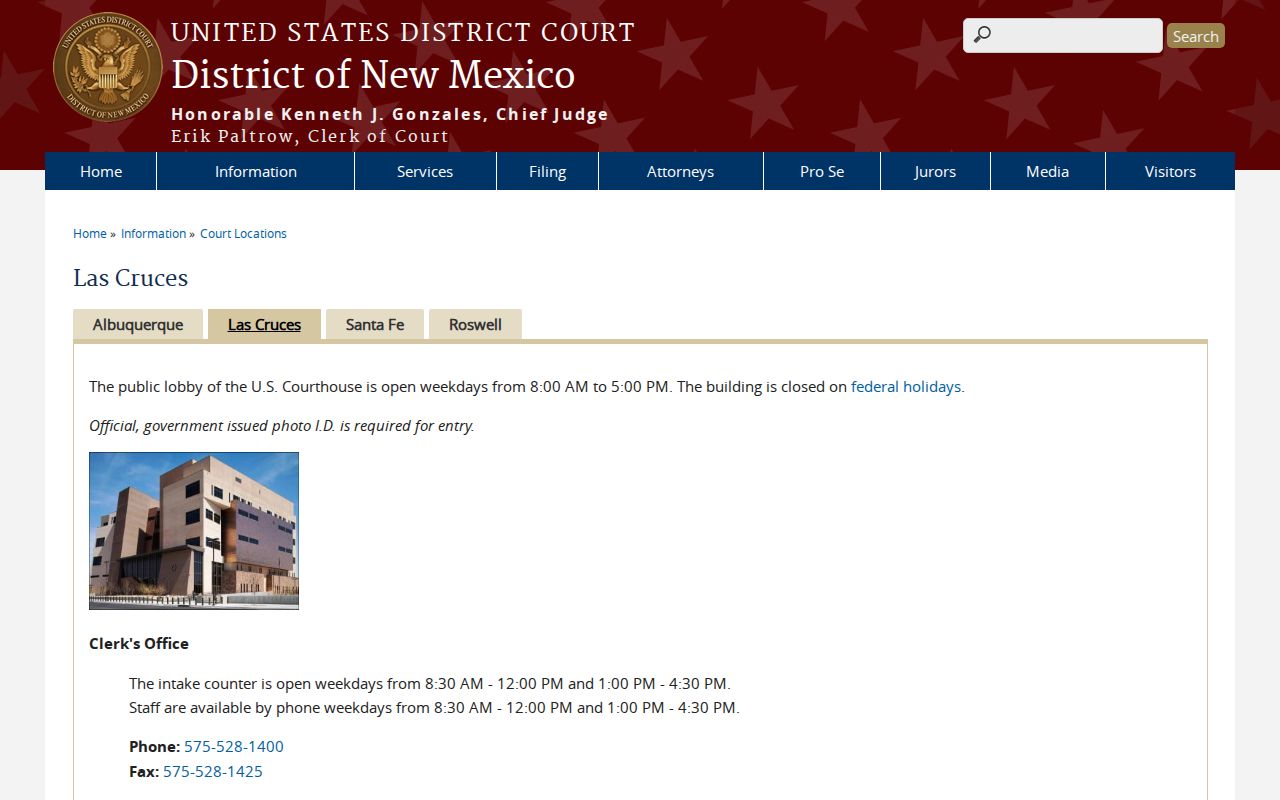
That federal page covers a courthouse route. It is not a Hidalgo County arrest warrant roster. The U.S. Marshals District of New Mexico page describes federal fugitive and task-force work, so it fits only a federal matter. A state arrest warrant stays with the New Mexico issuing court and the local or state officers authorized to serve it.